Wednesday, February 1, 2012

To My Old Master


I loved this story so much that I posted on facebook, twitter, and now putting it on the blog. This is from the excellent website, Letters of Note.

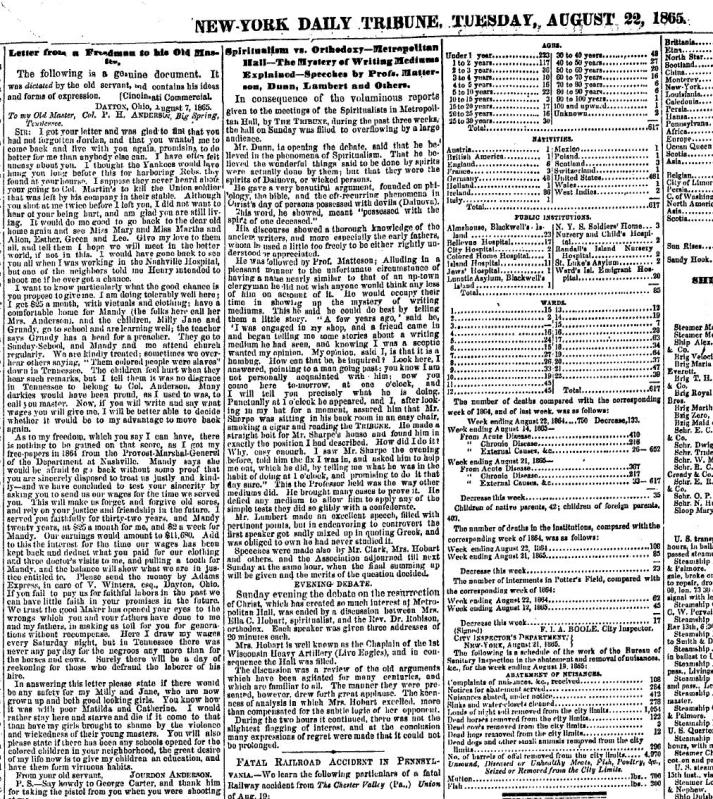
In August of 1865, a Colonel P.H. Anderson of Big Spring, Tennessee, wrote to his former slave, Jourdan Anderson, and requested that he come back to work on his farm. Jourdan — who, since being emancipated, had moved to Ohio, found paid work, and was now supporting his family — responded spectacularly by way of the letter seen below (a letter which, according to newspapers at the time, he dictated).

Rather than quote the numerous highlights in this letter, I'll simply leave you to enjoy it. Do make sure you read to the end.

(Source: The Freedmen's Book; Image: A group of escaped slaves in Virginia in 1862, courtesy of the Library of Congress.)

Dayton, Ohio,

August 7, 1865

To My Old Master, Colonel P.H. Anderson, Big Spring, Tennessee

Sir: I got your letter, and was glad to find that you had not forgotten Jourdon, and that you wanted me to come back and live with you again, promising to do better for me than anybody else can. I have often felt uneasy about you. I thought the Yankees would have hung you long before this, for harboring Rebs they found at your house. I suppose they never heard about your going to Colonel Martin's to kill the Union soldier that was left by his company in their stable. Although you shot at me twice before I left you, I did not want to hear of your being hurt, and am glad you are still living. It would do me good to go back to the dear old home again, and see Miss Mary and Miss Martha and Allen, Esther, Green, and Lee. Give my love to them all, and tell them I hope we will meet in the better world, if not in this. I would have gone back to see you all when I was working in the Nashville Hospital, but one of the neighbors told me that Henry intended to shoot me if he ever got a chance.

I want to know particularly what the good chance is you propose to give me. I am doing tolerably well here. I get twenty-five dollars a month, with victuals and clothing; have a comfortable home for Mandy,—the folks call her Mrs. Anderson,—and the children—Milly, Jane, and Grundy—go to school and are learning well. The teacher says Grundy has a head for a preacher. They go to Sunday school, and Mandy and me attend church regularly. We are kindly treated. Sometimes we overhear others saying, "Them colored people were slaves" down in Tennessee. The children feel hurt when they hear such remarks; but I tell them it was no disgrace in Tennessee to belong to Colonel Anderson. Many darkeys would have been proud, as I used to be, to call you master. Now if you will write and say what wages you will give me, I will be better able to decide whether it would be to my advantage to move back again.

As to my freedom, which you say I can have, there is nothing to be gained on that score, as I got my free papers in 1864 from the Provost-Marshal-General of the Department of Nashville. Mandy says she would be afraid to go back without some proof that you were disposed to treat us justly and kindly; and we have concluded to test your sincerity by asking you to send us our wages for the time we served you. This will make us forget and forgive old scores, and rely on your justice and friendship in the future. I served you faithfully for thirty-two years, and Mandy twenty years. At twenty-five dollars a month for me, and two dollars a week for Mandy, our earnings would amount to eleven thousand six hundred and eighty dollars. Add to this the interest for the time our wages have been kept back, and deduct what you paid for our clothing, and three doctor's visits to me, and pulling a tooth for Mandy, and the balance will show what we are in justice entitled to. Please send the money by Adams's Express, in care of V. Winters, Esq., Dayton, Ohio. If you fail to pay us for faithful labors in the past, we can have little faith in your promises in the future. We trust the good Maker has opened your eyes to the wrongs which you and your fathers have done to me and my fathers, in making us toil for you for generations without recompense. Here I draw my wages every Saturday night; but in Tennessee there was never any pay-day for the negroes any more than for the horses and cows. Surely there will be a day of reckoning for those who defraud the laborer of his hire.

In answering this letter, please state if there would be any safety for my Milly and Jane, who are now grown up, and both good-looking girls. You know how it was with poor Matilda and Catherine. I would rather stay here and starve—and die, if it come to that—than have my girls brought to shame by the violence and wickedness of their young masters. You will also please state if there has been any schools opened for the colored children in your neighborhood. The great desire of my life now is to give my children an education, and have them form virtuous habits.

Say howdy to George Carter, and thank him for taking the pistol from you when you were shooting at me.

From your old servant,

Jourdon Anderson.

Tuesday, January 31, 2012

At the Beach with Lama


I am aware that an African American man talking about alternative spirituality and mystical experiences isn't normal. That kind of thing is reserved for hippies, sweat lodges, and people from other countries. We are not granted the right to act on and speak of angels without robes or a pulpit. In short it falls under the category of 'crazy white people hobbies' along with sky diving, vision questing, and Burning Man festivals.

To be a Black gay man delving into mysticism without partaking of activism or performance enhancing drugs is something I don't normally see.

Venerable Lobsang Chunzom has been in deep silent retreat for over a year. She is my Lama and a high and holy Buddhist nun embarking on a 3-year silent retreat.

When she went into deep retreat a lot of people were sad or worried about what they were going to do without their teacher. The departure left me feeling confused. I wanted to feel sad but at the same time I figured I would hear from her in deep retreat. There are ways to hear and feel people without them being there. I have personally experienced this countless times.

Over the course of the past year there have been little hints, notes, and messages left around. Most are sacred and personal, so I keep those private. Other times I have just been prompted to push or move in a particular direction at a moment in time. In one case when our not-for-profit donations were down I was pushed to pay visit to a friend's house. I didn't want to go but the pull was so strong that I ended up taking a train out to visit this person. In turn she ended up writing donations checks for $28,000 to the organization that day. Nothing prepared me for that except a strange push coming from something that was far beyond my comprehension in that moment.

The most mystical experiences have happened in dreams or around them.

In the whispers of my waking I was prompted to explore the beach. The beach was a constant refrain in Lama Chunzom's teaching. Personally I have never felt either affinity or malice for beaches. I grew up in Miami and took them for granted like a New Yorker takes the Statue of Liberty as just a green lady on an island. I happened to be down in Miami helping out my parents. I met up with a visiting friend in the sterile Aventura Mall. She lamented that she didn't like this area, as it was too mean and artificial in its community and people. I had never thought about Aventura in that light because I went to school in the area and excepted the luxury cars and scowling jowls as a plastic surgeon's playground. She mentioned that her husband and her went to Haulover Beach, a place I've heard of it but had never been. It was a nude beach.

"Oh, I would never do that-"

I caught myself and cursed under my breath. I have a little agreement with myself. Whenever I find myself blurting out the words 'I would never do (blank)' then that is what I must do. It has to be done, otherwise that 'unwilling action' will linger in my mind. This doesn't mean I'll rob a bank or kill a man. Those are things typically not aligned with spirit (although Lord Buddha's Jataka Tales has several interesting tales that counter this). Often my 'I would never' statements are just in relation to things that scare me or challenge me. And I don't want anything 'safe' on my unwilling list.

On the next Buddhist holiday I knew what I had to do. Haulover Beach here we come! When I arrived I stared around self-consciously. Yep, this is the nude beach. Leathery tans, brown bottoms, and jiggling bodies moved on the white sand. It was a blur of caramel flesh. I walked to a quiet section and wondered if maybe this wasn't the right thing, as if there was something wrong or shameful with being nude. At times of uncertainty I look around for auspicious signs. And then I saw her/him. Walking down the sand toward me was a hermaphrodite. Tall, slender, nude, and talking on her cell. She had female breast and male genitals. It was such a strange sight that it had to mean something. How many times do you see a hermaphrodite? For me the answer is never...until now.

She crossed my path and continued in her conversation. Well they say angels are neither male nor female but a combination of both energies. I was looking for an auspicious sign and it doesn't get more attention-getting than that. I set up my blanket and altar with offerings.

I took off my shirt, shorts, underwear and sat down.  In the buff, Au naturale, as I was born. Then I noticed something. No one cared. There wasn't gasps, laughter, screams of horror, whistles, catcalls. There wasn't anything except sound of the ocean and seagulls. Families strolled around holding hands, couples put suntan lotion on each others, old guys were sipping on beer. They were just doing it without clothes and no one cared.

I read my prayers, meditated, and went for a swim. I didn't feel dirty or shameful. My self-consciousness melted away after a few minutes. I was free. My mind was the beach. Sun, joy, freedom, nothing hidden.

Shortly after that day the dreams started flowing even more. More hints and suggestions. I asked aloud without pretense or ambition about what I should do. Then I waited. My phone rang and I was invited to partake in my own silent retreat for a month in Nicaragua.  Never been, all sorts of questions, many reasons to say no,  many reasons to wait until I felt more comfortable. So I had to say yes. Yes, to a month-long silent retreat, to Nicaragua, to unexplored territory.

When I finished my Nicaragua retreat with some time to spare I knew what I had to do. I went to the beach. No nude beaches. Clothing mandatory but it was still where I had to go. I brought my prayer book. I prayed, swam, meditated and waited. The beach was empty. Out of thin air, a man appeared. He walked up to me and started talking about miracles. Certainly an auspicious sign after a deep retreat and on the beach of prayer. He sat down next to me and let me listen to "A Course in Miracles" on his iPod while swam.


When I came back to the United States I picked up "A Course in Miracles" and dove further into my quantum physics studies. It all blends together. There is nothing different except the terms. The miracle is right here, right now. When I awake to it there is nothing to do. I just have to allow. It is like coming out of a dream. There is no effort made by the dreamer. They arise as naturally as the sun.  And there is a beautiful power in this unforced ease that can only be described as grace. Grace is the allowance of saints and angels. It is what fills my heart/ And the wages of my days are being paid with this grace.

And despite it all doubt still arises.  That voice pops up to offer self-consciousness, cynicism, and second-guessing. Maybe it was all a bunch of magical thinking? This couldn't have happened. Doubt flows through my day in what I am and what I am seeing. It couldn't be that special? Because it was then that would mean that I, too, was on that same level. How egotistical of me to think that the universe is actually speaking to me, that my Lama is talking just to me throughout my day. Doubt screams that the rainstorm, the sun, the beach, this planet has nothing to do with me. I am just a rounding off error in some grand equation. How could it be that the beach was made for me, that the wind blows just to cool my face, that the sun shines just to light my day, that Buddhism and my Lama came just for me? Perhaps that is why the miracles come to me again and again like waves that wash over the boulders and wear them down into sand and dust. In time the softness of grace wins over the hardest doubt.

 In my dreams, my Lama came to me. I, the dreamer, gave prostration and she taught the finer points of what that action mean. The dreamer prostrated again after the lesson. When I awoke I became aware that my prostrations were missing the key points taught in the dream. Maybe that is why I received that lesson. I prostrated that morning before meditation with the new information in my heart. That was a teaching transmitted purely through the yoga of my dreams.

I surrender to these lessons and ask for greater space in my heart. May there be enough room in my heart for the dharma to continue flowing in my dreams and waking life. May I take the beach with me where ever I go.


Saturday, January 28, 2012

OJ and Me

We leaped into the air. Fists pounded desks and high-pitched shrieks pierced my ears. For a split second I felt a sharp electric jolt ripple across my chest. I think I pulled a muscle as I leaped out of my body and senses. Beyond comprehension, time and space. It remains one of the oddest transcendent moments in my life. The entire experience lasted a few seconds. And it all revolved two words: not guilty.

Our teacher, Mr. M, slammed off the TV and -with it- a packed Los Angeles courtroom gasping for air and OJ Simpson flickered to black. Mr. M was red-faced, shaking and  his trademark spittle gathered in white frothy globes on the side of his mouth.  I had never seen a teacher so angry in my entire life. Staring at his hunched and gasping frame, I came back to my senses and spot in the universe. North Miami Beach High School. Basic psychological class October 3, 1995. Fifth period after lunch.

I looked down at my own body. I was standing on my chair. How did I end up on my chair? What was I doing? What were we all doing?

Our collective explosion shocked no one more than us. Some students were contorted into frozen statutes of ecstasy while others had tears in our eyes. Waves of laughter rolled through the classroom. We looked ridiculous. Mistaking our laughter for joy instead of its real response -shock at our spontaneous eruption- Mr. M screamed at us. I have no idea what he was saying. Our laughter drowned out his tirade.

Let me be completely clear: I didn't care about the OJ Simpson trial. I had no investment or interests in him as a person or anyone involved. I avoided stand-up comedians, trial reporters, and Jay Leno's skits that found endless humor in a double murder trial. And few of my friends even talked about OJ, the trial, the surprises and reversals. Even the trial of the century and media maelstrom didn't stand a chance against the narcissism of high school students. This isn't about OJ Simpson. This is about our bizarre occurrence in that tiny high school classroom where, for one moment, a small group of mostly Black students lost their collective minds.

On June 16, 1995 I had nothing better to do with my life than watch one of the most boring NBA finals ever televised. Houston Rockets vs. New York Knicks. Pat Riley was a mythical figure in silk suits and slicked-back black mane. He oozed New York power and murderous charm. I loved Pat Riley, but I hated watching his Knicks team play. They bludgeoned, elbowed, and dragged the game's pace down. I rooted for this Knicks team because I wanted to see Riley win but, at the same time, I hated most of actual players responsible for winning a championship. I digress in this set-up only to explain my ambivalence in watching this free-throw contest posing as an NBA finals.

As I watched Knicks hack another Rockets player, I muted the sound and went to fridge to scavenge. When I came back, there was a split screen with the game on one side and that now infamous White Ford Bronco on the other side. I thought it was another made-for-LA news car chase. I turned up the sound and Tom Brokaw was in mid-sentence. He was hyping up the image of that very slow-moving truck dribbling down the highway.  Breaking news used to be reserved for acts of war, assassination, and natural disasters. This wasn't breaking or news. This was gossipy anticipation of a tragedy. Chopper cameras hovered overhead.

The truck continued creeping down the hallway joined by a convoy of police car. The ticker scrolled breaking news about a car chase in progress. Car chase? This wasn't a car chase.This was a tragic celebrity parade with a two-person float being watched by millions around the world. This was TV spectacle posing as news.

And yet the image was completely riveting because it was so mundane. The white bronco slowly trotting down the parade route was surreal. The car chase didn't have enough chase, which is exactly what made it such a silly and sad site. 

My eyes darted back and forth between basketball and a nation waiting for a sports hero to kill himself. They recounted OJ Simpson's life, his glorious career, his movie acting, his marriage. He was now cowering in the back of a car. Did he have a gun? Apparently he's under a blanket. So sad. Terrible tragedy. So when is he going to do it and please pass the popcorn.

Just out of curiosity I flipped to all the major networks and new channels. One by one they all began switching over to the OJ suicide parade. Commentators piling on, spurious news, alleged suicide notes. There was an argument with his ex-wife and murder victim. There were fights, he was at their children's recital the day before. Did they talk and what did they say? Was it jealousy?

He was, of course, guilty. The narrative, insinuated tone, and direction of the conversation flowed from that premise. At first it didn't effect me much. But I felt something stirring in my mind like a low-frequency buzz. This just didn't feel right and I had no idea why.  It was wrong but very familiar to my mind. The presumption of guilt felt like some essential paradigm that was both fundamentally flawed and thoroughly ingrained.

To complicate the matter, I found OJ's profile to reflect an unsympathetic jock at best and at worst, a nefarious bully and sociopath. My Dad had a signed letter from OJ in his office. In the note he was declining an invitation to speak to a group of students. My Dad kept this snub in his personal files for years, even though I found the tone of the letter dismissive. He wanted nothing to do with Black kids in the inner city, motivational speaking, or being a role model. The letter was a polite door being shut in my Dad's face and he cherished it like a nerd who mistakes a slap by the school cheerleader as foreplay.  OJ had movies, commercials, and mansions to tend.

The suicide parade continued down its mysterious route.  Drivers stopped on the overhead streets and cheered on the Bronco. They held up signs. RUN OJ! The cameras drank in the scene they were trying to paint as a national crisis but that kept getting undercut by rubberneckers, shameless OJ fans, and curiosity seekers. The gravitas of Tom Brokaw's voice eluded these supporting actors and extras.

The split marked a zenith moment in pop culture irony. One side showed the rewards of violence and aggressiveness as Knick players pushed and shoved their opponents into the ground. The other side of the screen showed the tragedy. Both sides of the TV streamed real-time the cheering fans, commercial breaks, and color commentators.

But OJ didn't kill himself in the parade, even though that was the intention of a nation's voyeuristic gaze. The public snuff movie lacked a dramatic conclusion as the star running back slowed to a dead stop. He was arrested and we waited for the next visual: the mugshot.

After the parade, I thought the story would trickle down to the level of People magazine and National Enquirer. I vastly underestimated the savvy intelligence of mass media and overestimated the decorum of national conversation.

The ratings came out. Through the roof. CNN, NBC, everyone. The magazines hit the news stands and Newsweek and Time set records. OJ was a one-man economic recovery plan. Talking heads, pundits, news graphic artists, camera men, photographers, courtroom reporters were snatched up. Criminal lawyers were hired to give their opinion and then, in a meta-media moment, some of the lawyers left the TV screen to join the trial. And it was such a bright, hopeful, and happy double homicide case. Everyone on screen was so beautiful, perky, and well-fed. With every passing day, a new titillation was leaked. The domestic violence in OJ's past, the timeline, Nicole's relation to other men, the hapless waiter, Mexican maids, and mooching house guests.

Somewhere in between darkening Simpson's mugshot and the Dancing Itos on the Tonight Show, that low-level irritation turned into resentment. That summer there was nowhere to turn to without hearing about OJ. Football training camp offered a brief respite. I immersed myself in the weight room and practice field. I used the controlled violence of football to shield myself from the murder case.

When school started that fall, there was an error in my class scheduling. I was an honors student placed in a 'regular' psychology class. When I tried to make the switch to honor psych, the administrators blocked me. Regular classes scared me. Although I loved hanging out with football players and athletes, I did not want to be in a classroom next to them. Honors students heard horror stories of 'normal classes' filled with rioting students and teachers swinging baseball bats.

My imagination went into overdrive as I pictured painted and tattoo'ed cannibals boiling the head of a substitute teacher in a witch's cauldron heated by a fire pit filled with textbooks and course plans. I enjoyed the occasional academic safari where regular students were mixed with the honors for a physical education workshop or school assembly. I got to see what passed for 'normal' education in Miami, shake my head, sigh, and then return to what I saw as the legitimate classroom with high-achievers and PhD trained teachers. Almost as punishment for my arrogance, I was blocked at every turn. Administrators wouldn't budge, couldn't be plied or persuaded.

Our teacher was a lovable burn-out. Balding with a fence of white straw hair around his head, Mr. M was a year away from retirement. He didn't mind telling students that on the first day. Basic psych was a warehouse, or a place to put undesirables, troublemakers, and students locked out of their preferred class. Almost all the students were Black with a few Latinos sprinkled in for diversity. The class called for a small reading list but we had no text books, manuals or workbooks. Mr. M said he was working on getting us our material and his promise felt meaningless. I knew that there would be snow on South Beach before we had our text books. I decided to observe this 'normal' group of students and a teacher counting down his days. Mr. M saw my transcript and knew that I didn't belong here. In his eyes I became his confidant, intellectual equal, someone he could turn to when the class got too rowdy. I just wanted my A+.

Mr. M tried relating to his mostly Black student population. He was Jewish and he noted that Black and Jews had a special relationship in this country. Jazz music, the civil rights movement, liberal politics were our people's link. The Black students looked at him at him like he was crazy before bursting out into laughter as if to say 'look at this old White fool.' I stayed neutral.

Students and teacher settled into mild acceptance after a few days. He would ask us to do as little work as possible and they would negotiate him down from there. Most days Mr. M was happy to oblige us in using the TV as our babysitter. He would play a documentary and then give a short pop quiz on basic psychological terms. In between TV shows he managed to slip a few facts about BF Skinner, baby ducks, and Pavlov's dog.

Things first came to a head over a Holocaust documentary. Mr. M intended on us watching a documentary about Nazi concentration camps. Students moaned, sucked their teeth, and sighed. When he asked if there was a problem he probably wasn't prepared for the response. They were tired of hearing about the Holocaust. They were tired of getting World War II shoved down their throats. Enough with Anne Frank. Enough with the Holocaust.

Mr. M looked over at me as if to say 'can you believe these guys?'  The students were aware that I was an honors student and debate captain. They looked to me to back up their arguments. I maintained my Swiss neutrality. 'M' grew visibly upset and red splotches dotted his face. He simmered.

 'What would you like to see then?'

"Something about Black history. What about our story?"

"Okay, we can watch 'Roots' if you want?"

"Damn! Nevermind!!"

But it was too late. Feelings were hurt. There would be no "Roots" or Holocaust movie. He made us take out our folders while he wrote on the board. As our punishment, he was going to teach. Students moaned and sucked their teeth even louder.

A few days before the OJ verdict, our basic psychology class had a discussion abou race that went something like this. It was, once again, the students vs. Mr. M. The discussion went something like this:

You don't really think he's innocent do you?

Black people get wrongfully convicted all the time.

Yes, but OJ is rich. And look at all the evidence.

Crooked cops do whatever they want. They can plant evidence.

But he fits the profile or an abuser. Don't use your emotions. You have to think.

Just because I don't think what you want me to think doesn't mean I'm not thinking.

But at the end of the day he'll probably be convicted.

Fuck the police. Fuck the judges, fuck this whole system. And fuck this class and school too.

We didn't talk about OJ any more. The only thing everyone agreed on was that he was going to be convicted and the punishment in the media and in the halls of justice would be even more severe for him. A few Black females hissed that the only reason people care about this so much is because it's a White woman. Some others called it as a circus lynch party, and I immediately thought back to Clarence Thomas's 'high-tech lynching' comment. If ever a thing like that existed, then this was certainly it.

On that day after lunch on October 3rd, Mr. M agreed to let us watch the OJ conviction verdict. He told us that he didn't want any yelling or hurt feelings. No anger , no 'fuck this school.' And it seemed as if many officials were bracing for a Rodney King style riot, begging for calm.

Sullen Black faces stared at the screen. It wasn't about OJ. I finally got it. My resentment, their anger wasn't about whether he did it or not. It was a slow seething rage against the arrogance of power. It was an arrogance of having justice always on one side. Black people live under this arrogance every day. This was unquestioned and unmentionable cloud that hung in our classroom and in our young lives. You were a presumed suspect from the start.

Something happened in that internationally televised moment. People paused in lobbies, cafeterias, and classrooms across the country. No more jokes, no more comments, and hypotheticals. The long scythe of justice was slicing through the air and we were all silently waiting. Anticipating the tragedy like we did in June as we watched the White Bronco in OJ's suicide parade.

And then he got away. They had the party ready, the coffin finished and the noose braid was oiled. Cotton candy had been sold, peanuts were boiling. The crowd gathered from around the world to see this Black man suffer, repent, and a blubber. To watch a symbol of power, wealth, and sports get down on his knees and beg for his life. Of course he would still be executed and eternally condemned but the begging just sweetened the voyeuristic pleasure. And then the unexpected happened: that nigger got away. That arrogant, rich, white-woman-loving nigger got away. I had never seen such a thing in my life. No one had.

The surrounding classrooms were silent. The teachers and administrators looked like they had 10 years taken off their lives. Janitors and security guards snickered and smiled 'have a nice day' to their fuming bosses.

The OJ trial was not a victory for Black people. There were no reparations won or rights restored. Black children were no better or worse for the scandal, and our basic psych class did not get our text books then nor ever. The OJ trial was a victory for OJ.

For the rest of us, the OJ Simpson was just another branch grafted on to a poison tree. A tree planted centuries ago and watered by the blood of many. If you are a person of color in America you have tasted the harvest. But for one moment, the bitter fruit was forced into the mouths of all those talking heads and bloviating pundits. And with a shocked look, they had to eat their words.


Thursday, January 26, 2012

Makeshift Wheelchair

My mom walked in and threw her purse on the chair. Her eyes were cast downward as she looked past me. She looked beat. It was another long afternoon at the doctor's office.

My Dad was in the car. I grabbed the wheelchair and rolled it down the ramp and set the brakes down so he could get out.

"What happened?"

"The doctors wanted him to go to the hospital but the insurance company refused. They were arguing over the phone so I told him we were going home."

My Dad has been plagued with a severe infection the past few months. He's bed-bound and spends the whole day looking at TV. He was in the hospital two months ago and given antibiotics. After a month of taking the pills, the infection still persists. His doctor set up an appointment this afternoon to get him admitted into the hospital to receive medicine intravenously. The insurance company says they won't pay for it because he doesn't need it.

My Dad sat down in the wheelchair and we backpedal up the ramp into the house. I have to keep my hands on the rubber handles because they slip off easily. It's a makeshift wheelchair. His actual wheelchair broke a year ago and the insurance company refused to honor payment for a new one because they said it was unnecessary. A family friend went out and found a used and damaged substitute. He fixed it up and brought it over that day and we've been using the same wheelchair ever since.

My mom looked ahead wearily. She fixed the bed and prepared dinner. After four years of work, they're realizing that they have makeshift health care. Like the wheelchair, their coverage has to be handled gingerly as it has been patched together. It breaks, it leaks, it collapses under the weight of its responsibility. The health care was built for earnings, not patients.

I wish to seem them living better. I'm no longer upset at the insurance industry. Where there was once animosity is now just sadness. We look forward, weary and sick of fighting. 


How to Play with Boys


Who were these creatures? Small, mean, and mad animals who delighted in torturing insects, small rodents, and each other. I didn’t understand how we were in the same species. They appeared to be the most excited when causing harm. I observed kindness mostly between adults and even then this exchange occurred infrequently; when a person was in danger or severe tragedy. The holding pattern for most boys was silent hostility and indifference.
When I was kindergarten a teenager from Highland Oaks Middle School would cross over to our grounds after school to push me down into the dirt, beat me up, and call me all sorts of names until I burst into tears. I was a faggot and it was his duty to hurt me. When I went to the teachers I was informed that I needed to change. Their advice was to stop playing house with girls, join the boys, try to fit in. My bullying was of my own doing. I needed to toughen up. I was 6.
I liked playing house, I enjoyed the company of children who preferred imagination and role playing instead of competition and fear. There was no pushing, no worries when playing house. If I raised my voice in confrontation this would make most of the girls burst into tears or run to the teacher. So we played house with delicate voices and concern for each other’s feelings. Wasn’t this a virtue? Shouldn’t I be praised for having some modicum of kindness and love? And besides, I was one of the only boys in class who actually preferred playing house. When boys were selected to stay inside and work with my imaginary stove and pots, they hated it. They banged the pots, would try to break the chairs, and send girls running away in tears. When I had to stay inside I celebrated. Although I wasn’t crazy about the whole taking care of a baby, I enjoyed the fake meals, cleaning, creating a domestic soap opera.
But if what the adults were saying was true, then playing house could be my downfall. I couldn’t stand the thought getting beaten up for years. My fear of my teenage tormentor won out over my love of playing house. The first time I voluntarily choose to play outside the teacher was startled. Then she smiled as if something proper and righteous had been restored in my action. I was going to give this a try.
Dense blankets of red and brown leaves covered Highland Oaks Elementary school grounds. These musty leaves could be kicked up, thrown around, used as burying material for another kid or gathered in a giant pile to be run through. I was amongst the cavemen now. The boys looked at me suspiciously. I didn’t know whether this experiment was going to work. Once we were outside everyone dispersed into the woods, running around buildings, screaming, climbing up poles, ripping the bark off trees. This was my play now.
The playing was free, chaotic, often destructive, combative, competitive. Playing with boys was both immensely freeing and depressing. On the one hand I found most of our play to be idiotic and confusing. We would create rules but quickly break them whenever it was convenient. I knew enough not to be that know-it-all kid trying to correct others. I stayed back and watched how the dynamics played out. Games would pop up and then quickly end. On the other hand, playing with boys made me more observant of competition, games, arguing, and fighting for a cause.
Our play seemed to divided into 5 or 6 boy tribes. You were expected to play, eat at lunch, and hang out with your tribe. The strongest or most popular kids had veto powers over anything and could sometimes go over into another tribe and temporarily take it over. Highland Oaks was a public school with a mostly Jewish student body. Each tribe had a different level of social power not only with the students but even the teachers. The lowest group was composed of Latinos, Blacks, and some effeminate boys. Although they welcomed me into their games on my first day on the playground, I made sure to never play with them again. I was trying to improve my social standing. The bottom tribe wasn’t worth the effort. The teachers frequently punished them and they were prey to all the boys.
The next two groups up from the bottom was comprised mostly of the same kind of mixture but had less gays and a few outspoken leaders. The highest tribe was the gold stars, filled with alpha dogs, mostly Jewish kids who played together at the JCC, came from wealthy families, and were extremely outspoken and combative. Often it was difficult to tell if these boys even liked each other. They spent so much time trying to outdo themselves, get around teacher rules, and harass the girls that I knew I couldn’t be a part of their tribe. It would be too much of a betrayal to my girls to go from playing house with them to putting gum in their hair. Furthermore, I knew they probably wouldn’t let me in. Therefore I aimed for the silver medal.
The silver tribe had a Latino kid in it. The leader seemed strong but not too mean. I would be the Black kid in their group, offering my unique perspective. When I first approached them, I put on my most casual stroll and walked into the middle of their games. I looked around, smiling, looking for an invitation. None was forthcoming. In fact, their leaders pulled the tribe away from me and into a different part of the woods. This was going to be more difficult than I thought. I wandered through the woods fighting back my tears. I wanted to go back inside for a nice cup of fake tea and a bowl of fake soup. I trudged around thinking, my feet kicking massive piles of leaves. One of the boys from the silver tribe came over to me and started kicking leaves at me. I realized this was some sort of aggressive ritual invitation to play.
I kicked some leaves back at him. He picked up and giant pile and I picked a giant pile. Pretty soon we were hurling these mud-covered lumps of leaves at each other, laughing and running around the trees. I pretended to enjoy myself by screaming in my loudest outdoor voice and waving my arms around. I was faking it. Soon two silver tribesmen came over and joined in this chaotic mess. I discovered that I had some outstanding traits: I was quite fast and strong in comparison to my fellow classmates. Perhaps this Black thing was already working to my advantage. I could jump and outrace most of the kids on the ground. Furthermore I could add in some of my role playing skills from my times playing house. The leaf toss became a battleground and I was leading the charge.
I made sure to advertise how much fun we were having to others. When an effeminate boy from the lowest tribe tried to join in, I ignored him and pushed our game farther in the opposite direction. I couldn’t risk my entrance by associating with my own kind. Pretty soon we were making so much noise that I had dragged away half the tribe to my side. Fearing a mutiny, the leaders joined in my game. I keep changing roles, new story lines when the boys started to get bored, I added in an interesting rule or a twist. And I could outrace them to the gun warehouse (i.e. where we stocked our special leaves) and back to the front lines.
My time playing with girls greatly benefited me. I used my attuned sensitivity to manage relationships, avoid conflicts before they started, and practiced playground diplomacy between different tribes. I also stood by silently when effeminate boys were beaten up. My loyalty in the boy's club would have been threatened by any signs of compassion for the weaker kids: the faggots, freaks, and unattractive girls. The teenager stopped beating me up. A few years later we played basketball together. He considered me a friend and confided in me his girlfriend decisions. I could barely contain the desire to stomp his face in when he smiled at me.
Playing with boys helped me learn to stop crying. Pain was something to endure. My feelings and emotions weren't discussed or considered. Power was the only currency honored. Underneath my skin, I burned. My childhood was filled with fevers, flu bouts, phlegmatic congestion, headaches, and electric fire that rippled through my little hands and feet. No one knew how my often my physical body ached from psychosomatic rage. I consumed the fire. 
Suicide became a viable option by the end of the 6th grade. I was fascinated with my final solution. The idea seemed easy enough. The devil was in the details. I didn’t know enough about poisons, hanging looked gruesome, and slitting wrist appeared to be unsuccessful most of the time. The easiest way was with a gun. My Dad had at least two stored in his closet, high above the raincoats and sports jackets. Gun one was a black and dense. The snub-nose reminded me of my favorite novels. James Bond, however, probably used something which was thinner and not and with a lighter trigger. Gun two was a shimmering chrome revolver with a cream colored handled. The Lone Ranger would holster a gun like this. I felt heroic when I held the Lone Ranger pistol in my hand. Death didn’t seem so flawed. The voices encouraged my hobby.
You will always be alone.
You are disgusting.
How could anyone ever love you?
Planning satisfied the voices and kept me occupied. How does an adolescent prepare for death? You have to map these things out very carefully. I agonized over the location. The living room, my bedroom, the bathroom.
What about the note? What should I say? What could be said? I was unhappy, but who commits suicide in a festive mood?
When I turned 13, I made an agreement with myself. One year. If my life didn't improve in one year, I would kill myself. Six years of this fire was enough. I began shutting down, seeing how long I could go without saying a word in class or at home. Some times I lasted for days.
I began thinking about my last year and what I wanted to see out of my life. My interests in music faded. I quit playing the violin and stopped listening to the radio. Oblivious to my thoughts, my parents left me at home and I stewed in my last year, clutching my Dad's guns, writing out notes. 
Then I discovered the aerobics tapes my sister left behind. I started working out that summer, first for 30 minutes, then an hour, and pretty soon 3-4 hours a day. One aerobics tape after another, all day long. The living room smelled like sweat. No violin, no music, no friends. It was just me and Charlene Prickett. She was my saint. I listened to her every day as she pushed through these bouncing dance moves with her two disciples, standing on opposite sides. We worked cardio, floor pilates, abs. Discipline. I discovered self-discipline in figuring out foods to eat. I quit eating candy. I stopped drinking soda on a whim one day (and have never picked it up again). My own private boot camp prepared me for my last year and the beginning of school.
When I returned to junior high school something had shifted. I was still pudgy and soft around the edges. But my beer belly was gone. I could take my shirt off in basketball without gasps of laughter and falling rolls of flesh. I  found refuge once again in play. Sports equalized myself and the bullies. 
 In basketball I was a tough rebounder, shot blocker, and would rip the ball out of opponents hands like I was picking oranges. In football, I scored every time I caught the ball because no one suspected the dough-soft Black kid had any speed or skills. In boxball I beat all challengers. My hands and feet were quicker and stronger most challengers from hours of aerobic workout tapes and I used those appendages to their fullest. The teasing lasted only as long as it took to change in the locker room. I wouldn't have to see these kids in my honors classes. I just had to endure them in short bursts. I managed the fear. 
Honing myself year after year, I became an award-winning tennis player, then all-state wrestler and football player in high school. I sought validation in the very boy's club I despised. I picked up with my music listening strictly from what was played on team buses and before games. Gangsta rap and grunge music. The fade was pitch perfect for my feelings. Years before Columbine I imagined walking through the lockerroom and school gyms with submachine guns blazing. I saw blood explode out of their mouths as I gunned down my own teammates over a soundtrack of Snoop Dogg and Dr. Dre. Nightmares were frequent. 
At the end of the year, I found myself tolerated by most, liked by a few, and grudgingly respected by the bullies. Maybe I could wait another year to decide? No, I had made an agreement with myself and I was determined to keep in strict adherence to the contract. Discipline is needed for these types of situations. It was either all or nothing. Suicide now or never. But what had I been doing this whole time but killing myself through abusive negation and self-disgust? It wasn't suicide now or never. It was suicide: slow or fast? For most of my childhood I had been choosing slow. 
Suddenly it occurred to me that maybe I was asking the wrong question. Instead of choosing the method and speed of suicide, maybe I should make a decision between this way and life? What would a life look like? I may be alone, I may be unpopular, but what do I want in my life? I didn't want peer approval. I found it thoroughly unsatisfying to judge myself according to the opinion of others. These were cavemen, boys who still enjoyed torturing little animals and humiliating themselves. After all these years I had no more respect for them now then when I was in kindergarten. So what did I want? Not ten years from now, or next week, what did I want right there in that moment? Music.
I haven't listened to my own music all year. Not locker room, pre-game songs blasted out on a stereo. My music. I turned to MTV. Soulful cooing and up-tempo grooves blasted out of the speakers. A woman in a baseball cap and spandex shorts was dancing around in a group. She was searching for a 'real love." To this day I always remember what the song I broke my music celibacy to: Mary J. Blige's "Real Love." Nothing could have been more appropriate. Every time I hear that song I think about that day when I was trying to decide between suicide or life.
Then it was Guns N' Roses "November Rain" and a flurry of songs that were all about the same thing: love. The issue was settled then. No more suicide, not now or ever. Not fast or slow. I wanted music, friends, and a chance at real play. Not competition, not blood sport. Real play. Joy, fun, doing what kids do. School became different. The teasing that once tortured me, now rolled off my back. I was a little fat. So what? I was gay. There had to be at least someone else in history who was also. There had to be others. Someone else out there has to be having a similar experience of alienation whether gay, straight, Black or White. Maybe one day we'll meet. Maybe I can seek them out. And then we can learn how to love and play.   


Saturday, January 21, 2012

Obama Syndrome

I stood before my classmates with a clean shirt, adjusting my cardboard-stiff collar. Anxiously flicking some cards in my hands,  I looked for somewhere to place my eyes. Searching my audience, most faces were blank, some hostile, some beaming. None were Black. I was 9-years-old and running for class secretary.

My teacher smiled and urged me to step forward. I edged away from the blackboard and delivered my 'stump speech.' I didn't even use the note cards as my blasted through my speech from sheer adrenaline. My classmates were stunned. For a second-grader to regurgitate a 2-minute written speech without uttering an 'um' or stutter was the equivalent of the Gettysburg Address. For the only Black student in class to do this was like delivery the Gettysburg Address while juggling flaming knives.

Waves of applause and smiles. One of my opponents shuddered and slumped in his seat. My other rival quickly raised his hand as soon the applause subsided. He was withdrawing. My slumping opponent quickly added a motion to invalidate his candidacy.

The following year the same thing happened. Applause and opponents running for the exits.
In elementary school, high school, and college I ran for various offices.  I never lost. My victories came in landslides, often with the opponent withdrawing their bid.  My standard speech guaranteed competence, communication, and working with others. Hardly riveting material but I realized at an early age what a professional salesman learns: it's more effective to sell yourself than a product. I crafted myself but realized that I didn't have complete control over my narrative. Often the audiences came with their own.

I call it Black articulitis but it could easily be renamed the Obama Syndrome.  They see me as a blank slate for dreams and nightmares. Post-race America offers a dangerous conundrum for Blacks. Freed from the civil rights movements, most of my friends don't think in terns of overt race and class status. It is,however, a mistake to then declare all things being equal. There is an identity vacuum for young Black adults. And this is being filled, oddly enough, by White mainstream culture. Blackness has become a white canvas that everyone paints on except Black people themselves. It's no coincidence that you have 60-year-old white male politicians coming forward with how they would act if they were Black. It's also no coincidence that youth culture funnels its lingo, clothes, and music directly from hip hop with no awareness. It's arrogance taken to a new level. Black culture and Blackness has more to do with people's false fears and delusional hopes than actual history.

From the benevolent but condescending left-wing perspective, the Obama syndrome means that they identify with their progressive roots by aligning themselves with Blackness. There's a secret thrill in validating their Black friend that turns the latter into a puppet. The actual views of said Black friend aren't really as important as their face and presence in the room. I have often felt as if I was an intellectual mascot sitting in on important decisions.

At North Miami Beach high school I was chair of our congressional debate team. In every tournament I competed in I won. Our school also won the Harvard Debate Tournament that year. When I began sweeping every tournament I entered, I remember a classmate turning to me and saying 'man I should really try out this congressional debate thing.' He wasn't asking for advice or guidance from an award-winning debater. He was, in effect, saying 'wow, if YOU can win, then it must be easy. I should try that out.' This person never sought my advice even though I was the chair of the debate section he wished to enter. He was stunned when he learned he would actually have to answer to me. It's fine to have a Black mascot but it's another thing when you have to take orders from one. Even more astonishing to his ego, he wasn't that successful in his debates. Unable to compute how I could be skilled at something he failed at, he quit and became a backbench critic of what I needed to do.

In our senior year we were encouraged to post our college of choice on a giant poster. A few debaters really wanted to go to Northwestern. I had never heard of the school but I applied, got some scholarships, and decided to go. I walked up to the poster and -with a purple marker- wrote Northwestern by my name.

"Oh. Wow. That's...great.'

They had an odd way of congratulating me. In fact it was so uncomfortable I felt as if I was the new kid in school who came in had stolen their dream girlfriend. I didn't want to talk about my alma mater because the questions would start.

"Is it a football scholarship?"

"Well you know the only reason they picked you is because you're Black. Hahaha! Just kidding."

At Northwestern University I worked for the school newspaper and was one of the few freshman students who had actually been paid as a reporter in high school. At the end of the year, the arts editor wanted me to take his place in the film section. There was another writer who wanted that position and was shocked that he has been passed over. He was a White man from a rich family. He came to me and suggested we co-edit the arts section. When I politely declined to share a position I was promoted to, he seemed outraged. He claimed that he was owed it. If I suggested that I was owed something, my parents would have beaten me. But to him, it was outrageous that he wasn't given his rightful due. I was being the uppity one and, in a phone conversation, he tried to put me in my place by suggesting my selection had more to do with articulitis than talent. He wasn't doing it as a favor to me. He could offer the 'skill' part of being the editor. As my knuckles turned white, I controlled my voice in biding my friend a goodbye.

I wasn't being seen. These were liberals, many of them my friends. l was their proof of racial inclusiveness, but it was only on their terms. When I excelled past the acceptable point I went from being a hopeful sign to a government quota, and then I had to be put in my place.

From the right-wing perspective the Obama syndrome causes mass paranoia, suspicion, and delusions of impotence. To a poor White audience, an articulate Black man embodies all their failures. They can acknowledge his success, but are quick to 'put him in his place.' It is, of course, their job to do this. And they love their job.

When Barack Obama came to the national stage in 2004 I found him charming. I wasn't prepared for mainstream drooling over his sharp, crisp demeanor. Granted, I think he's one of the best orators of our generation. But in 2004 most of this was unfounded. He was being compared to JFK, RFK, Lincoln, and Black Jesus all rolled into one.

Barack Obama was also a Muslim, radical Islamo-fascist, Madrassa-educated, Chicago socialist, radical totalitarian. He was going to take away our guns, our God, and our beloved capitalism. Nothing in Obama's words or actions suggests Jesus or Mussolini.  And yet the drumbeat of insanity continues. He has no control over his identity, his Blackness is the storm wall for graffiti artist from different gangs: constantly shifting, edited, embellished, and contradicted.

Barack Obama both fascinates and scares me. As he ends his first term in office, many of my concerns about his leadership have been justified, many of my hopes for his vision have been dashed, and some times I wonder if I made the right choice. The old nagging reactionary liberal voice screams 'should've been Hillary" as I watch with embarrassment as a great leader feels so much smaller in daily political discourse than in my dreams.

But there is no way he could have lived up to all my dreams and nightmares. I find myself falling under the same syndrome I have been a victim of in my life. I bought into the 'magical Negro' and there is nothing to suggest Obama was selling this. He's a moderate, competent, intelligent leader who happens to be Black. He's not Moses and nothing in his biography suggests a Biblical leader delivering us from our problems. And to be quite honest, if Barack Obama was Barry O'Donald from Kansas I doubt he would be this hated, this put-upon. Then again, Barry probably wouldn't be as dynamic and interesting as a public inkblot test.

A few years ago I applied for an editing job at a financial journal to practice my resume and cover letter skills. To my surprise they called me in for an interview. I was thoroughly unqualified for the position but I was told to never turn down an interview. I put on a clean shirt and adjusted the stiff collar as I sat in the waiting room. When the managing editor, a British woman,  saw that I was the one being interviewed, her face showed a slight confusion that turned into a smile. We went into the room and her looked over my resume as we talked. She knew I wasn't qualified and I didn't care; I wanted to practice my interview skills. I wondered if I still had that second-grader inside of me, able to tap into articulitis.

When she hinted that I didn't fit the background they were looking for, that made me even more determined. I was spinning the most creative answers from thin air and making them seem solid. What should have been a 10-minute interviewed stretched on for 30, 40 minutes and an hour. I was holding court, dazzling, joking, giving astute answers for a field of financial journalism I knew nothing about. Doubt crept into the editor's face. Maybe she had judged me wrong.

I was leveraging the Obama Syndrome, wrestling it back from her wary and mistrustful assumptions. I sold myself like a door-to-door insurance policy. I am the magical Negro. I articulate, gesticulate, and conversate at an A+ level with no hint of anger or animosity. I am aware of history but find it rather amusing instead of condemning. I am this company's best Black friend. Don't bother to read the fine-print. You must love me. Loving me means that you are forgiven. All will the dirt will be washed away once you sign on the dotted line and don't bother to read the fine print. Don't you want to feel clean and absolved of any nagging sense of privilege? Don't you want to be saved?

Adrenaline rushed through me as I fell under the spell of self-creation. We were both madly in love with a 3rd person, a scrappy, young, fierce (but not angry) outsider called "Aurin Squire." No, this was becoming something much bigger than an insurance sell. This was my beast and my baby. I looked at this noble statue-esque figure, warmly smiling with his head thrown back and eyes pointed toward the sunrise. My God, he was beautiful. I wanted to applaud. Like Dr. Frankenstein, I wanted to hail my creation, this lumbering child-like beast composed of a patchwork parts from the Sidney Poitier Cemetery of noble Negros. Sure this creation might scare some of the villagers into hysteria but I found it beautiful. And yes, this Frankenstein-ian being might find itself un-loved and un-approachable but look at how strong and big it looks compared to its inventor. I, the creator, am so much less. Filled with doubt, sarcasm, malice, and arrogance, I am merely human. But my frailties are viewed that much more unfavorably because I happen to be Black. And so I created in my image, this "Aurin Squire."

The editor rushed out of the room and quickly brought back another editor. Two more people came into the room. British who, no doubt, viewed their open-minded nature as superior to their gun-toting, cross-burning, slave-owning American counterparts.

"When can you start?"

I deflated. What? You want to hire me? But I don't even want or need this job. I just wanted to prove you wrong. Reality returned like a splash of cold water. I sobered up. I looked around at this room of smiling White faces. I began to stutter as 'ums' and 'ahhs' entered my now mundane vernacular. I was back to being just me. I told them I was just ending a job right now. Yes, of course, someone as epic as "Aurin Squire" doesn't just start tomorrow. Planets orbit around him and you can't expect him to drop his plans on the spot any more than you could expect the sun to shift its axis on a whim.

A pang of consciousness started beating in my chest. It grew louder and louder. I lead these people on out of my anger, out of my arrogance, and out of my fears of being rejected. I delayed and said I would have to think about it. The editors showed me around the office, where my desk would be, the co-workers who looked on approvingly. I felt as if I was the main float in a parade. Exiting the office, the beating grew louder in my chest. Acid ate at my stomach as I descended into the subway.

I wanted a short meaningless fling and they had their wedding dress on and were waiting at the chapel. But you don't enter into a relationship with the "Aurin Squire" I invented. You can't because my creation isn't real. There's no heart, no emotion, but just a patchwork of mythical parts. You wed yourself to that myth and all you'll have for your honeymoon is...me. And 'me' isn't mythical or epic. I mutter, I stutter, and have doubts. My anger runs hot and cold, I'm impetuous and aggravating. And I lead people on. People who are vulnerable, depressed, looking for something or someone to be hopeful about in their life. I use the blank canvas of my Blackness as a con game because it has been used against me so many times. I deceive people who are looking for nobility and honor in a world full of groundlings and serfs. I conjure Black magic for people looking for excitement. People like you.

Some times I feel like a chameleon who has changed so many times to suit so many different environments that he has forgotten his original skin. I wonder if President Obama ever sits up at night worrying about who he has to be tomorrow? What to paint on the canvas of "Barack Obama?"

Whenever I start to feel drunk on grand delusions, I catch myself.  I am not magical, nor am I the devil. I don't have to be my own God and yet I can live in grace. Black articulitis is not a lifelong sentence, only a passing flu. I just hope I'm not passing it on to others.


Friday, January 20, 2012

Dreams: Impotent Justice

Last night I had several haunting dreams flow together into a funeral. Before going to sleep I a series of auspicious and unusual things occurred.

First off, the lock on the front door broke. This lock has been there for decades. My mom came home and was struggling with the lock. I went to open it and found that I couldn't either. The seal had been broken and now the lock just turned, around and around with the key, never settling down. I had to open the storage room side door.

The next thing that was unusual was my general mood that could be described as anxiously nauseous or resentfully uneasy. To alleviate this I swam in the gym pool, also out of the norm for me. For the last two days I have been annoyed at what I perceived were personal sacrifices on my time. Resentment sickened and sapped my mind. I was not in a happy Buddha space, but in resentful martyr mode. None of my old appetites appealed to me. Hence, my trip to LA Fitness.

I jumped in the empty pool and began doing leisure backstrokes and froggies. My glasses were in my locker so I could only see the colored blurs swirling around the pool. I stared up as the ceiling as I swam and thought. This resentment was not healthy. It was not real. I felt I was being asked to do too much, from too many people, for too little in return. I rattled off my lists and thought of the daily meditation. Letting go of grievances. Thus, I was presented with my litany today and then told that my schedule would have to change to accommodate the plans of others.

God's law is the only law. 

I thought about all that people were expected to do for me. All the things that I thought were owed to me. These were my laws and when they were broken, my ego demanded punishment. But unable to find and inflict punishment on anyone, I just seethed. Not a lot and certainly not at the point of rage. But just enough anger to keep my mind nauseous with resentment. I  was the courtroom with no power. I was bringing up charges against criminals, sentencing them in absentia, and then watching them walk around right outside my window. Screaming would be beneath the judge,  so he just sit in the room, sneering at all the convicted criminals roaming around outside.

My laws, my judgment, my resentment. What would it be like if I didn't have that? I am so tired of this courtroom. What if it didn't exist? What if no one owed me anything?

I swam for a half hour before another swimmer jumped into the lane right next to me. He was gliding through the water, zipping up and down the pool, splashing me with water as I leisurely swam. I looked at how fast he was moving. My mind started commentary: he's a much better swimmer than you are. He's showing off. Did he have to get in the lane right next to me and start splashing around like he's Michael Phelps? Asshole.

Enough. God's law is the only law. The guy isn't showing off. I don't even know if he's a better swimmer than me. I don't even know if he's a man. I just see a blob. That's my story. I created all of that instantly. I continued swimming along. After an hour my hands were prunes and raisins. It was time for bed.

I fell asleep more at ease on the surface than when I began swimming. But obviously my mind had other ideas that night as a series of bizarre dreams crept up.

In one setting I am driving around looking for a drive-thru. I'm not finding any places and there are no signs. The roads are empty and the hedges run along both sides. I turn into a Burger King parking lot. The building is colored chalk white and looks to be under construction. There is a giant truck blocking the drive-thru lane. Staring at the building from my car I determine that the place is empty. As if to defy me, a light flickers on. I zoom in closer and see that it's a flame burning inside. There is someone in there cooking. I could go in. I get scared and decide to keep driving.

And I moved into giant procession. I have lost my car. There are pilgrims migrating toward a great site. I notice some men in orange tunics, others in maroon robes. This must be something holy. I follow the crowds who have orange paint on their faces and move toward a structure that can only be described at this time as mountain-building hybrid. The steps are carved into the earth and people are seated on them. I stop at the outskirts of the sitting assembly. A monk in maroon robes looks at me. His face changes from curiosity to dislike. I'm hurt. What did I do to him? There is another man in orange robes, who may be a monk or jut a pilgrim. His face shows neither like nor dislike. He just looks at me. I make my way through the crowd but I'm scared. Singing, chanting of unknown origin is going on. Suddenly an intermission is called. Significant amounts of people wander away, some turn to their neighbors. The break in group concentration gives me the courage to move forward.

As I get closer to the front I see there is a coffin there. I feel sick and sad. Some poor, great saint has passed on and now people are honoring him. I intuit that this would be someone I never met. At the front of this structure which has now shifted into resembling an open-air temple, I see a friend who I shall call Ross. Ross is grieving. She says the name of the deceased and I'm shaken. It's an old friend from college who I shall call -for the sake of anonymity- Nathan C.

The dream has become frightening. This feels very real. In fact when I woke up this morning I instantly went to the computer and checked my old college friend on Facebook. I went to his status and made sure no one had posted any condolences. Apparently he is still alive. In the dream he was not. I didn't want to know any more. Suddenly I wasn't an observer. I wanted to cry and mourn. I recalled all the great times we had together. Nathan was such a free spirit and always made me feel better. When I lived in the dorms at Northwestern I would go to Nathan when I was depressed. Now he was gone, his life ended abruptly and much too young.

Ross informed me that the cause of death was impotence. Or to quote verbatim from my own dream, Ross said 'He died from impotence' and continued crying. Wait. No one dies from impotence. This is still a dream. I reassured myself that no one dies from impotence. This is a dream, yet the power of the setting was so strong that I kept slipping back into depression about Nathan's death.

When I awoke this morning I checked my phone for messages. Then I went to the computer to make sure Nathan wasn't dead. After my senses had been restored I began thinking what that was about.

It's very unusual for anyone to say something in my dream that I would remember. But I definitely remember the 'he died from impotence' line. It was too Freudian to forget. If I read it in a dramatic script I might roll my eyes as the psycho-babble.

I went to acupuncture and then the beach. That line and the dream have haunted me all day. What died? Perhaps some of my resentment died, unable to exercise its power any more of my subconscious. Perhaps some of my anger perished in my search for Burger King. Or were they memories of past wrongs, drained of their ability to enrage me. It seemed like a happy impotence.

The overwhelming feeling last night and throughout the dream was nauseous and anxiety. I kept thinking "I feel sick,' and then I'm in a funeral dream talking about impotence-induced death. Maybe I don't have to judge as much today. I can surrender my impotent law to a higher power.

Looking for Bubba Jesus: Left-wing Patriotism

Left-patriotism. I feel like this is circling around our conversations. What does it look like, how do we redefine it? Right now the Dems ha...